How a sliding gate is sized
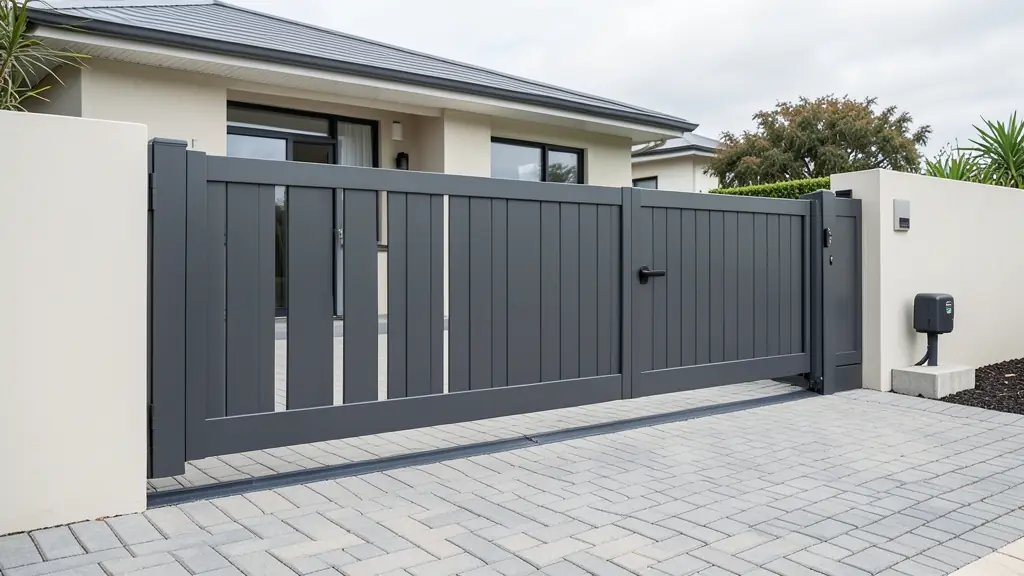
A sliding gate is always longer than the opening. It runs along a ground track and needs to overlap the catch post when it is closed, so a typical gate is about 300 mm longer than the opening. When the gate opens, it slides to the side behind the wall or fence, so you need clear, level run-back space at least as long as the gate, plus a little for the end stop.
The track runs across the opening and along the run-back, and a gear rack is fixed along the bottom of the gate for the motor's drive gear. Guide rollers at the top keep the gate upright, and anti-lift brackets stop anyone lifting it off the track.
Choosing a gate motor
Gate motors are rated by the maximum mass of gate they can move. Pick a motor rated well above the weight of your gate, because a motor working at its limit wears out sooner, and wind, slopes and stiff rollers all add load. The calculator estimates a mass range from the gate's size and style and suggests a rating about 1.5 times the upper figure.
- Light mesh and aluminium gates suit smaller domestic motors.
- Steel palisade and solid steel driveway gates usually need a 500 kg to 1 000 kg motor.
- Long industrial gates need heavy-duty or industrial motors.
Ask for a battery backup so the gate keeps working during load shedding, and anti-theft brackets for the motor.
When a sliding gate does not fit
If there is not enough run-back space, a sliding gate can still work in other forms. A bi-parting gate uses two leaves that slide apart, each needing only half the space. A telescopic gate has two leaves that slide behind each other. Where the driveway is level and there is room in front of the opening, a double swing gate may be simpler.
Get a quote for your project
The figures above are an estimate for planning. For an exact price, press Add these figures to my quote and send the form. A fencing contractor in your area will measure up and send you a free quote, with no obligation.
Frequently asked questions
How much space do I need for a sliding gate?
You need clear space beside the opening at least as long as the gate, which is usually the opening width plus about 300 mm, with a little more for the end stop. A 4 m opening needs about 4.6 m of run-back space.
How heavy is a steel sliding gate?
It depends on the size and design. A 4.3 m by 1.8 m steel palisade gate typically weighs roughly 140 to 220 kg, while a solid steel gate of the same size can weigh 200 to 300 kg or more. Ask the manufacturer for the actual mass before choosing a motor.
What size gate motor do I need?
Choose a motor rated for at least 1.5 times the gate's mass. For many domestic steel gates that means a 500 kg or 800 kg motor. Heavy or long gates need a 1 000 kg motor or larger.